

Life Insurance Is Not an Estate Plan—But It Can Make Your Estate Plan Work
September is Life Insurance Awareness Month — but most people only ask "do I have enough coverage?" The better question is what happens to that coverage the day it's actually used. Four real-world California scenarios show why a policy and a trust need to be built to work together, not just exist side by side.

“Ya Se Sabe” Is Not an Estate Plan: Protecting the Family Legacy
In many Hispanic households, talking about death and money openly can feel disrespectful — even like tempting fate. But when a beloved matriarch in Temecula passes away without a trust or will, her children learn the hard way that "everyone already knows" isn't a legal document. California Probate Code has its own plan for your family, and it doesn't ask what anyone assumed.

How AI Is Changing the First Step of Estate Planning, Not the Last
More people are turning to AI to organize their thoughts before an estate planning appointment — and that's a good thing. But when it comes to what actually protects your family under California law, there's no substitute for an attorney in the loop. Here's how the two work together.

Big News for Your Estate Plan: The Federal Estate Tax Exemption Jumps to $15 Million in 2026
The federal estate and gift tax exemption jumped to $15 million per person in 2026. Here's why California families still need an estate plan — and what to check in yours.

When Your Business Dies With You: The California Succession Gap Every Practice Owner Misses
Your estate plan may protect your personal assets—but does it protect your business? Learn why business owners need a coordinated succession plan that addresses who can step in, keep operations moving, and protect the value of what you’ve built if you die or become incapacitated.

What is a legacy letter?
Most people think estate planning is about passing down money and property. While legal documents are essential, they don't preserve your stories, your values, or the love that defines your family. Discover why a legacy letter may become the most treasured gift you ever leave behind—and how it can complement your estate plan for generations to come.
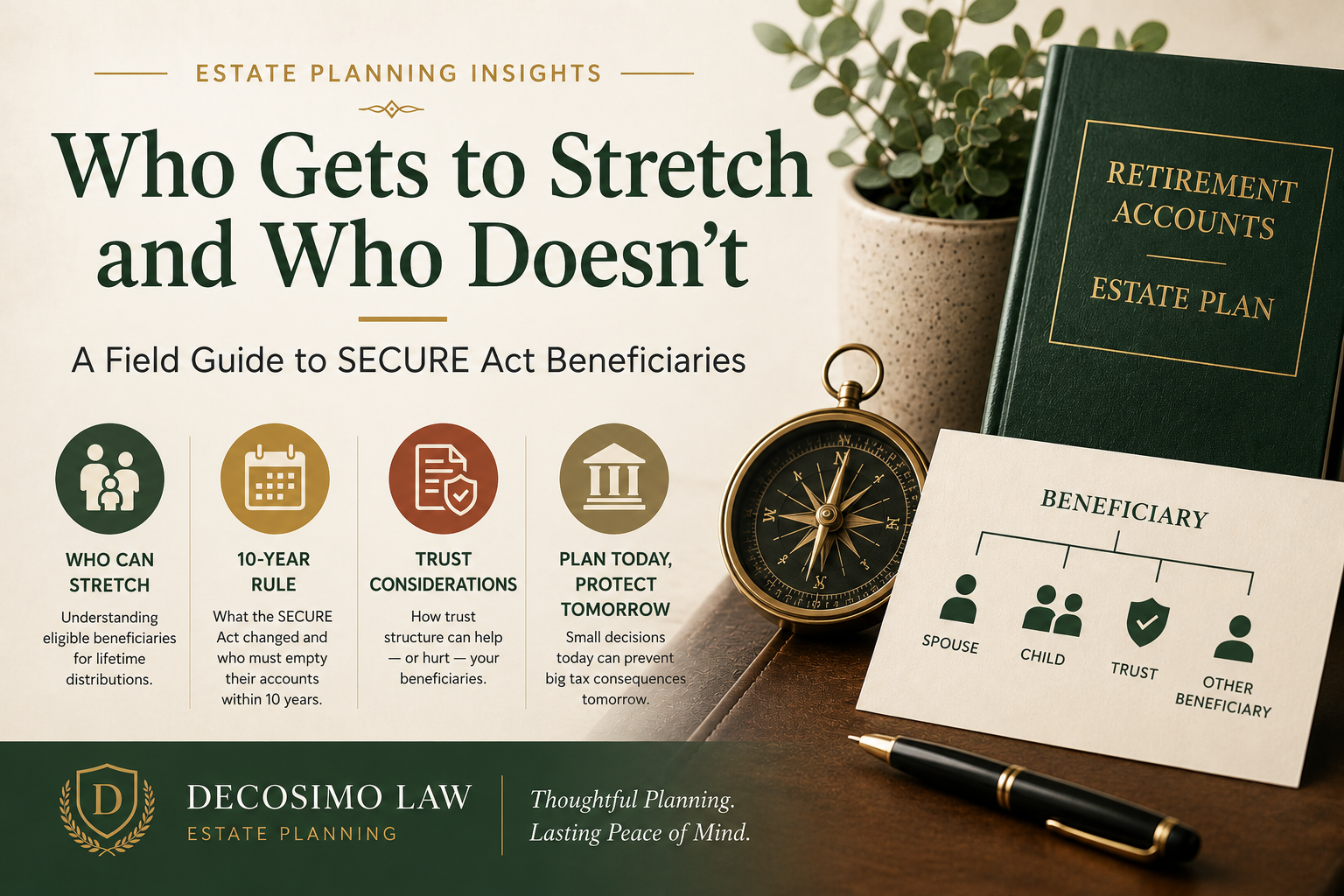
Inherited an IRA? The SECURE Act Determines Whether You Get Five Years, Ten Years, or a Lifetime
Who you name as the beneficiary of your IRA or retirement account can have a much bigger impact than most people realize. The SECURE Act created different categories of beneficiaries, each with its own distribution timeline and tax consequences. Understanding these rules can help your family avoid unnecessary taxes and preserve more of your legacy.

The Clock That Doesn't Wait for the Courthouse: Prop 19 and California Probate Delays
When Marisol's father passed away, she assumed she had a year to decide whether to move into his home. What she didn't realize is that the clock started on his date of death — not the day probate finally released the house into her name. This is the story of how California's Prop 19 deadline and slow-moving probate courts can quietly collide, and what families can do before it happens to them.

The "When I'm Gone" Workbook: One of the Greatest Gifts You Can Leave Your Loved Ones
A trust or will tells your family who inherits what. It doesn't tell them where the extra house key is, what the WiFi password is, or who to call about the gutters. That's where a simple workbook comes in — and it might be the most meaningful thing you leave behind.

The Summer of Transfers: Why Gifting to Your Kids in 2026 Could Backfire on You
Summer is when Southern California families make big financial moves — helping adult kids buy a home, handing down the rental property, writing the big check. But in 2026, two California-specific rules can turn an act of generosity into a serious financial problem. Here's what you need to know before you sign anything.

The Government Changed the Rules on Long-Term Care. Here's What Every California Family Needs to Know.
Your mother has a paid-off house and some savings. You've always assumed Medi-Cal would be there if she ever needed a nursing home. That assumption just got a lot more complicated. In the span of a single year, two major legal changes — one from Washington D.C., one from Sacramento — have quietly rewritten the rules on long-term care in California. They affect whether your parents can qualify for help, how much they'll need to spend first, and whether the family home will still be there to inherit when they're gone.

The Trust Was Supposed to Protect Everything. It Didn't.
You paid for a living trust in California — but is your home actually in it? Thousands of families discover too late that an unfunded trust offers zero protection. Here's what to check and why it matters more than ever in 2026.

When Beneficiary Designations Fail in California
You filled out the beneficiary designation form. You put names on it. You assumed it was done. But in California, three separate bodies of law — federal ERISA spousal consent rules, the SECURE Act's elimination of the stretch IRA, and California's community property statutes — can each independently override what that form says. This article walks through a real California family's story and explains exactly how all three can fail at once.

The Sandwich Generation
You're driving your mom to her cardiologist, helping with third-grade homework, and somehow keeping your job together — all at once. If you're in the sandwich generation, your estate plan isn't just about what happens when you die. It's about what happens if you can't show up tomorrow. Here's what California families caught in the middle need to have in place — right now.

Rev Up Your Estate Plan: Classic Cars - What Happens When the Keys Change Hands
That vintage Mustang in your garage isn't just a showpiece — it's a legacy. We break down what California collectors need to know in 2026: from probate shortcuts and Transfer-on-Death titles to the tax break that could save your heirs thousands.

Her Husband Died Without a Will. Then ICE Came to the Door.
ou may think estate planning is only about who inherits your assets. In reality, it is also about protecting the people you love during the most vulnerable moments of their lives. The reported story of Marie-Thérèse Ross-Mahé shows how quickly grief, family conflict, housing insecurity, and legal confusion can spiral after a spouse dies without a plan. For blended families, second marriages, and families with international ties, proper planning can make all the difference.

He Sold His Company for $1.2 Billion. He Died Without an Estate Plan
Tony Hsieh sold Zappos to Amazon for $1.2 billion and built one of the most admired companies in America. When he died at 46 without a will or a trust, his family was left to sort out an estate worth hundreds of millions of dollars. Publicly, slowly, and painfully. What happened next is a lesson everyone who has something to protect should read. Read more...

Trust Administration in California – Part 2: The First Few Months
The first 60–120 days of trust administration in California carry strict legal duties and deadlines. From the 60-day notice requirement under Probate Code §16061.7 to securing assets and obtaining date-of-death valuations, trustees must act carefully to avoid liability. Here’s a legally grounded guide to what happens next.

Trust Administration 101 Basics — Part I: Before You Accept the Role of Trustee
Being named trustee comes with real responsibility—and real risk. This guide explains what to consider before accepting the role and how to approach trust administration the right way.
A good estate plan tries to make the trustee’s job bigger and the executor’s job smaller.
In California, a trustee and an executor may be the same person, but they are not the same job. This article explains who handles trust assets, who handles probate, when court authority is required, and why clear planning can save families time, money, and conflict.